
12 Volt Fridge vs Thermoelectric Cooler: Which Should You Buy?
Plug-in coolers come in two very different kinds. A thermoelectric cooler — the classic Koolatron, Coleman or Igloo — is light, inexpensive and can also keep food warm, but it only cools to about 40°F below the outside air. A 12-volt compressor fridge works like a small refrigerator: it holds the temperature you set, freezes if you want it to, and cycles off once it is cold. Here is how to choose, and the models we carry of each.
- Thermoelectric: cools to about 40°F below the outside air, can also warm, light and inexpensive — but cannot freeze, and struggles in a hot car
- Compressor fridge: holds a set temperature, freezes, and keeps working on a hot day, but is heavier and costs more
- A thermoelectric cooler draws its full 3–4.5 amps the whole time it is plugged in; a compressor fridge switches off once it is cold and has battery protection
- Both run from a 12-volt socket; most compressor fridges also run on 24 volts and household AC
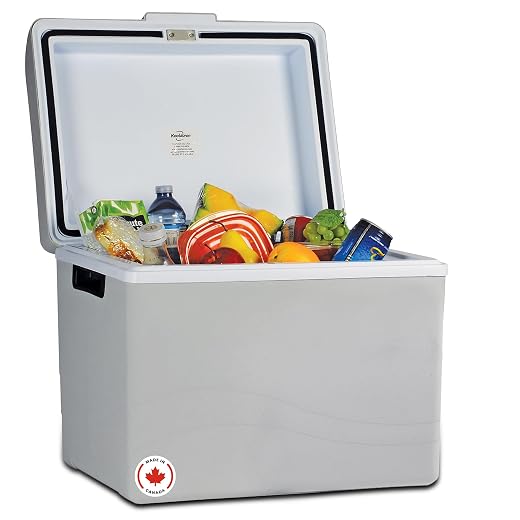
 Thermoelectric, 29 qt
Koolatron P‑27 Voyager
|
VS |
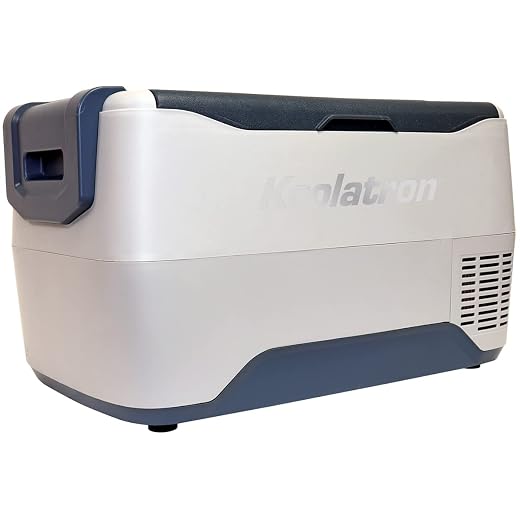
 Compressor, 30 qt
BougeRV CR28
|
|---|---|---|
|
About 41°F below the outside air
|
How cold |
Holds the temperature you set, -8°F to 50°F
|
|
No
|
Freezes |
Yes
|
|
Yes, 130–140°F
|
Warms |
No
|
|
Up to 4.5 A (48 W), all the time it is on
|
Power |
About 45 W in ECO mode, cycling off once cold
|
|
None built in
|
Battery protection |
3-level, adjustable
|
|
11.1 lb
|
Weight |
24.3 lb
|
| BUY NOW | BUY NOW |
Compressor fridges by size


When a thermoelectric cooler is enough


What is the difference between a thermoelectric cooler and a 12-volt fridge?
A thermoelectric cooler uses a solid-state Peltier module: it is light, quiet, cheap and can warm as well as cool, but it can only cool to about 40°F below the outside air and never freezes. A 12-volt fridge uses a small compressor like a household refrigerator, so it holds whatever temperature you set — fridge or freezer — even on a hot day.
Can a thermoelectric cooler freeze food or keep ice cream?
No. It cools to about 40°F below the outside air, so in a 70°F room it reaches about 30°F at best, but in a 90°F car only about 50°F. To freeze, or to keep food safely cold in summer heat, you need a compressor fridge.
Which uses less battery power?
Usually the compressor fridge. A thermoelectric cooler draws its full 3 to 4.5 amps the whole time it is plugged in — roughly 70 to 110 amp-hours a day — while a compressor fridge switches off once it reaches temperature. Most compressor fridges also have adjustable battery protection that shuts them off before the vehicle battery runs too low. For a thermoelectric cooler, a plug-in battery saver does the same job; see our Koolatron parts page.
Can I run a 12-volt fridge at home?
Yes. Most compressor fridges, and all the ones we list, come with an AC adapter or cord for a household outlet as well as a 12/24-volt DC cord. Off-grid, run it straight from the battery on DC rather than through an inverter; the inverter calculator helps if you power other things too.
Does a 12-volt fridge keep food warm too?
Generally not — compressor fridges cool and freeze. If you want one box that can also keep a hot dish warm, a thermoelectric cooler-warmer such as the Koolatron P-27 or P-95 does both.
What size do I need?
As a rough guide: around 20–23 quarts for one person or day trips, 30–37 quarts for a weekend for two, and 45 quarts or more — or a dual-zone model — for families, longer trips or keeping a freezer section.
Bottom line
If you want an inexpensive, light box that keeps drinks cool on a drive — and sometimes keeps food warm — a thermoelectric cooler such as the Koolatron P-27 is still a good buy. If you need food to stay properly cold in summer, want to freeze, or run off a battery for days, buy a compressor fridge: the BougeRV CR22 and EUHOMY 23 qt are the low-cost compacts, the CR28, EUHOMY 48 qt and BODEGA dual zone step up in size, and the ICECO GO20 and Dometic CFX2 are the premium picks.