
24 Volt Inverters Compared: 300 to 3000 Watts, Pure Sine
A 24-volt inverter does the same job as a 12-volt one at half the current, which means lighter cable, less power lost in it and an easier install at the higher wattages. It is the right choice when your battery bank or vehicle already runs at 24 volts — and only then, because an inverter works at one battery voltage. Here is how the 24-volt inverters we carry compare, from 300 to 3,000 watts.
- Match the inverter to your battery voltage: a 24-volt inverter will not run from a 12-volt battery, and a 12-volt inverter must never be connected to 24 volts
- At the same wattage, 24 volts draws half the amps of 12 volts: about 140 amps instead of 280 for a 3,000-watt load
- Every 24-volt model here is Samlex pure sine wave with two GFCI-protected outlets, so the choice is mainly about size
- To run 12-volt accessories from a 24-volt system, you need a 24-to-12-volt converter, not an inverter
Pick by what you are running


| Continuous power | Full-load draw at 24 V | Hard-wire option | Typical loads | ||
|---|---|---|---|---|---|
|
Samlex PST‑300‑24
Electronics
|
300 W | ~14 A | Not listed | Laptop, TV, chargers, CPAP | BUY NOW |
|
Samlex PST‑600‑24
Compact
|
600 W | ~28 A | Not listed | TV, electronics, small tools | BUY NOW |
|
Samlex PST‑1000‑24
Tools and small appliances
|
1,000 W | ~46 A | Not listed | Power tools, small appliances | BUY NOW |
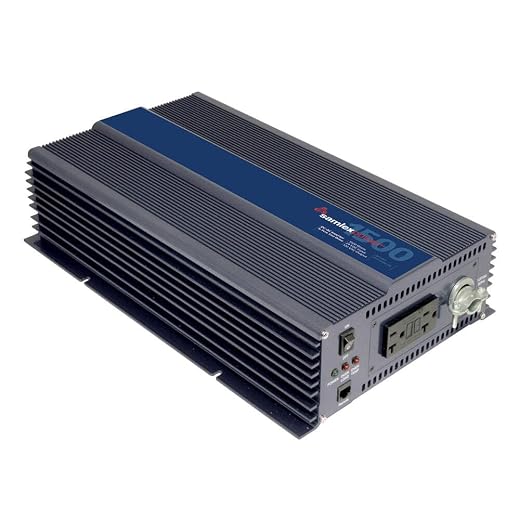
Samlex PST‑1500‑24
Compact microwave
|
1,500 W | ~69 A | Yes | Compact microwave, coffee maker | BUY NOW |
|
Samlex PST‑2000‑24
Most versatile
|
2,000 W | ~93 A | Yes | Microwave plus other loads | BUY NOW |
|
Samlex PST‑3000‑24
Heaviest loads
|
3,000 W | ~140 A | Yes | Several large appliances | BUY NOW |
Is a 24-volt inverter better than a 12-volt one?
Not better, but easier to wire at higher wattages. At the same power a 24-volt inverter draws half the current, so the battery cable can be lighter and less power is lost in it. Choose it when your batteries are already wired for 24 volts — many larger boats, buses, off-grid solar banks and some trucks and heavy equipment are. If your system is 12 volts, buy a 12-volt inverter.
Can I use a 24-volt inverter on a 12-volt battery?
No. A 24-volt inverter sees 12 volts as a dead battery and will not run — Samlex’s 24-volt PST models need at least about 21 volts. The reverse is worse: connecting a 12-volt inverter to 24 volts can destroy it. Each Samlex model works at one voltage, shown by the -12 or -24 at the end of the model number.
How many amps does a 24-volt inverter draw?
Roughly the watts divided by 24, plus about 10% for losses: about 46 amps for a 1,000-watt load, 93 amps for 2,000 watts and 140 amps for 3,000 watts. That is half what the same load draws at 12 volts. Our inverter calculator works it out for your loads and gives the cable size.
How do I get 24 volts from 12-volt batteries?
Wire two 12-volt batteries of the same type, capacity and age in series: the positive of one to the negative of the other, and take 24 volts from the two remaining terminals. Charge them as a 24-volt bank with a 24-volt charger. Mixing old and new batteries in a series bank wears out the weaker one quickly.
Can I run 12-volt accessories on a 24-volt system?
Yes, with a 24-to-12-volt DC converter rather than an inverter — an inverter makes 120-volt AC, a converter steps the DC voltage down. We carry Samlex 24-to-12-volt converters from 5 to 60 amps. Never tap 12 volts from one battery of a 24-volt bank; it unbalances the batteries.
What cable and fuse does a 24-volt inverter need?
Size the cable for the current and the length of the run — the inverter calculator gives the gauge — and fit a fuse close to the battery, usually Class T at the higher wattages; our Class T fuse guide compares them. Go Power’s installation kits are rated for 24-volt inverters too: the GP-DC-KIT2 for 600 to 1,800 watts and the GP-DC-KIT3 for 2,000 to 3,000 watts.
Bottom line
First make sure your system really is 24 volts; then size the inverter on what you will run at the same time, with headroom for anything with a motor. The Samlex PST-300-24 and PST-600-24 cover electronics, the PST-1000-24 and PST-1500-24 handle tools and a compact microwave, and the PST-2000-24 is the most versatile all-rounder. For the heaviest loads, the PST-3000-24 draws half the current of a 12-volt equivalent. Use our inverter calculator to check the size and the cable.