Inverter Installation Kits Compared: The Right Cable and Fuse for Your Inverter
An inverter installation kit is the pair of heavy battery cables and the fuse that connect an inverter to its battery. It matters more than it looks: cable that is too thin runs hot and starves the inverter of voltage, and an unfused cable leaves a battery that can push thousands of amps into a short. The kits below, from Samlex America and Go Power, come ready-lugged to bolt straight on. Here is how to match one to your inverter.
- Size the kit to the inverter: at 12 volts an inverter draws about 10 amps for every 100 watts it delivers, and the kit’s fuse and cable must carry that
- Every kit has two 10-foot cables with lugs fitted (15 feet for the Samlex DC-2500-KIT-XL), plus the fuse, its holder and mounting hardware
- The fuse goes on the positive cable, as close to the battery as you can mount it
- Your inverter’s manual names the cable and fuse it needs — where it differs from this guide, follow the manual
Pick by inverter size (12 volt)


| 12 V inverter | Fuse | Cable | Length | ||
|---|---|---|---|---|---|
|
Samlex DC‑1000‑KIT
Up to 1,000 W
|
Up to 1,000 W | 100 A marine battery fuse | #4 AWG | 2 × 10 ft | BUY NOW |

Go Power GP‑DC‑KIT2
600–1,000 W
|
600–1,000 W | 100 A Class T | #4 AWG | 2 × 10 ft | BUY NOW |
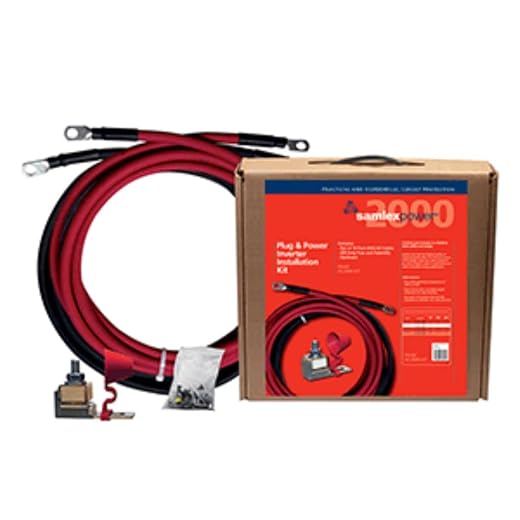
Samlex DC‑2000‑KIT
1,100–1,800 W
|
1,100–1,800 W | 200 A marine battery fuse | #2 AWG | 2 × 10 ft | BUY NOW |
|
Go Power GP‑DC‑KIT3
1,100–1,800 W
|
1,100–1,800 W | 200 A Class T | #2 AWG | 2 × 10 ft | BUY NOW |

Samlex DC‑2500‑KIT
2,000–2,500 W
|
2,000–2,500 W | 300 A marine battery fuse | 2/0 AWG | 2 × 10 ft | BUY NOW |
|
Go Power GP‑DC‑KIT4
2,000–2,500 W
|
2,000–2,500 W | 300 A Class T | 2/0 AWG | 2 × 10 ft | BUY NOW |
|
Samlex DC‑2500‑KIT‑XL
2,000–2,500 W, longer runs
|
2,000–2,500 W | 300 A marine battery fuse | 2/0 AWG | 2 × 15 ft | BUY NOW |
|
Go Power GP‑DC‑KIT5
2,600–3,000 W
|
2,600–3,000 W | 400 A Class T | 4/0 AWG | 2 × 10 ft | BUY NOW |
What size installation kit do I need for my inverter?
Go by the inverter’s continuous rating and battery voltage. At 12 volts an inverter draws about 10 amps per 100 watts, so a 1,000-watt inverter needs a 100-amp kit, 1,100 to 1,800 watts a 200-amp kit, 2,000 to 2,500 watts a 300-amp kit and 2,600 to 3,000 watts a 400-amp kit. The inverter’s manual lists the fuse and cable it wants, and that takes priority. Comparing inverters too? See our 1,000 W, 1,500 W, 2,000 W and 3,000 W guides.
What about 24-volt inverters?
At 24 volts the current is halved, so each kit covers roughly twice the wattage. Go Power rates its kits for 24-volt inverters as follows: GP-DC-KIT2 600 to 1,800 watts, GP-DC-KIT3 2,000 to 3,000 watts, GP-DC-KIT4 3,100 to 4,000 watts and GP-DC-KIT5 4,100 to 6,000 watts. See our 24-volt inverters compared guide for the inverters themselves.
Why does the inverter calculator suggest thicker cable than the kit?
They answer different questions. A kit’s cable is sized to carry the inverter’s current safely over its 10-foot length. The inverter calculator sizes cable for voltage drop — 3% by default — over the run you enter, which is stricter. For example, #2 cable on a 10-foot run at a full 1,500 watts loses about 4% of the battery’s voltage. That is fine for most uses, but if you run near full power for long periods, or the inverter shuts down on low voltage under heavy loads, choose the next kit up or move the inverter closer to the battery.
Where should the fuse go?
On the positive cable, as close to the battery as you can mount it — Go Power says usually within about 2 feet. The fuse is there to protect the cable: if it is ever cut or crushed against metal, the fuse blows before the cable can overheat and start a fire. Everything between the battery and the fuse is unprotected, which is why that length should be as short as possible.
What is the difference between the Class T and marine battery fuses?
Both are built for the very high current a battery can deliver into a short circuit. The Go Power kits use a Class T slow-blow fuse in a fuse block: it rides through an inverter’s start-up surge but opens fast on a true short, and its very high interrupting rating makes it the usual choice with large lithium banks. The Samlex kits use a marine-rated battery fuse with a high interrupting capacity on a fuse bar. Either is correct when sized to the inverter. More on Class T fuses in our Class T fuses compared guide.
Can I shorten or lengthen the cables?
The cables come with lugs fitted, so cutting them means fitting new lugs with a proper crimper for cable this size. If the inverter has to be more than 10 feet from the battery, choose the Samlex DC-2500-KIT-XL with 15-foot cables, or use the inverter calculator to work out a heavier cable for the longer run. Wherever you can, mount the inverter close to the battery and run the AC wiring further instead — AC wiring carries a tenth of the current.
Do I need anything else?
Most inverters also have a chassis ground terminal, which should be connected to the vehicle frame or the boat’s ground with its own wire — the manual gives the size. Make sure the inverter is switched off and the fuse is out while you connect the cables, and follow the connection order in the inverter’s manual.
Bottom line
Match the kit to your inverter’s size and battery voltage, mount the fuse on the positive cable right by the battery, and keep the run as short as the kit allows. At 12 volts: a 100-amp kit (Samlex DC-1000-KIT or Go Power GP-DC-KIT2) up to 1,000 watts, a 200-amp kit (GP-DC-KIT3 or DC-2000-KIT) to 1,800 watts, a 300-amp kit (GP-DC-KIT4, DC-2500-KIT, or the 15-foot DC-2500-KIT-XL) to 2,500 watts, and the 400-amp GP-DC-KIT5 to 3,000 watts. When in doubt, follow the inverter’s manual.